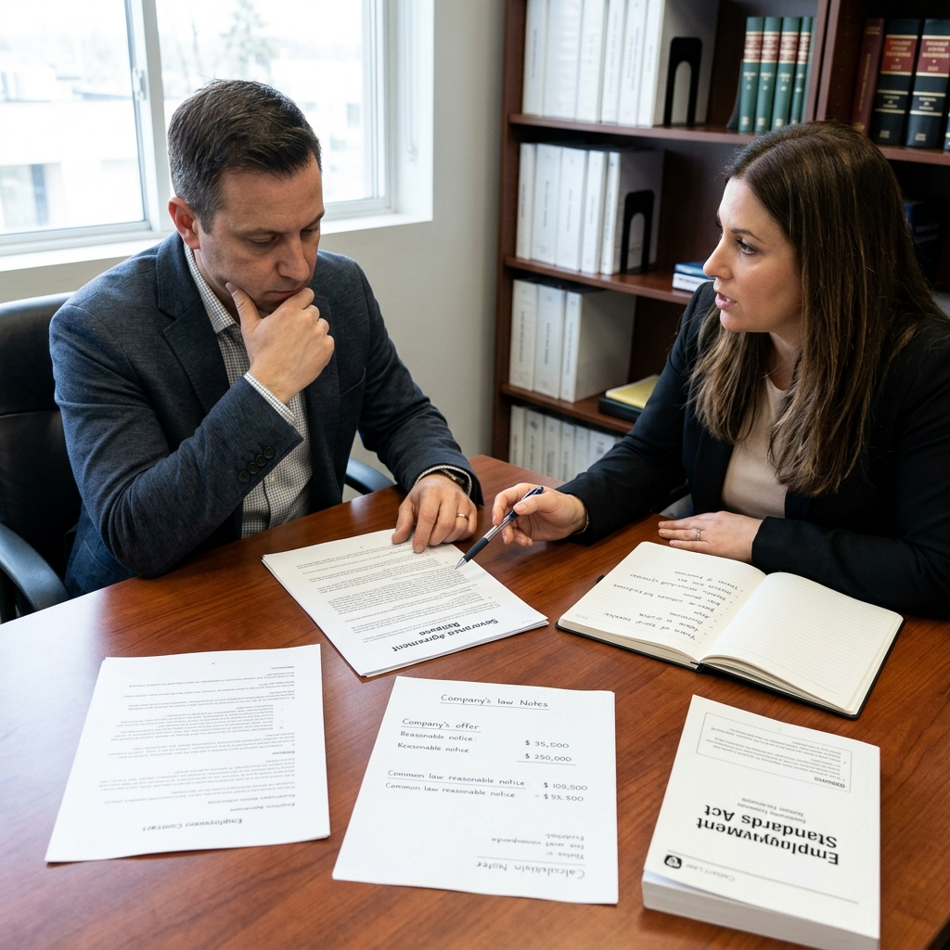

Losing your job unexpectedly can be stressful and confusing, especially if you are being pressured to sign severance papers quickly. In Ontario, wrongful dismissal often occurs when an employer lets someone go without providing the full notice or compensation they are entitled to. Many employees are entitled to more than they realize.
A Mississauga wrongful dismissal lawyer can explain your rights, review what your employer has offered, and help you decide whether it is fair before you sign anything.
Acting early helps you avoid signing away rights in a rushed severance meeting.
Ontario’s Employment Standards Act (ESA) sets minimums, but common law notice can be significantly higher based on factors like your age, length of service, position, and job market conditions. In addition to notice, some employees with five or more years of service may qualify for ESA severance pay if certain employer-size or downsizing thresholds are met.
A thorough severance pay assessment can uncover everything you’re legally owed before you accept an offer. Contact us at 905-629-8040 for a Free Case Review today.
What is a Constructive Dismissal Claim?
Not every case involves an outright firing. If your employer unilaterally makes fundamental changes that make it unreasonable to continue working, you may have a constructive dismissal claim. Examples include:
- A significant reduction in pay, bonuses, or hours without consent
- A demotion or major change in duties that undermines your role
- A toxic or harassing work environment, the employer fails to address
- Forced relocation far beyond a reasonable commuting distance
- Suspension without pay or improper “probation” used as pressure
Strict deadlines apply. Most civil claims in Ontario carry a two‑year limitation period, and employers often set short response windows on severance offers. Do not feel pressured to sign a release on the spot; get independent advice and tailored wrongful dismissal legal support before you agree to anything.
Cariati Law guides employees through employment law disputes Ontario workers commonly face, from without‑cause terminations to constructive dismissal. The team offers free initial consultations, no upfront fees, and strategic severance package reviews. The goal is to secure the maximum possible severance compensation through negotiation or, when needed, litigation.
With a track record of results, Cariati Law provides the local advocacy Mississauga employees need to protect their rights and move forward with confidence. Contact us at 905-629-8040 for a Free Case Review today.
How a Wrongful Dismissal Lawyer Evaluates Your Termination
A Mississauga wrongful dismissal lawyer starts by mapping the facts around your exit: the reason given (cause vs. no cause), the timeline, any performance issues raised, and whether you were pressured to sign a release. They’ll flag immediate risks—tight signing deadlines, benefits cutoffs, and a two‑year limitation period for court claims in Ontario. Early advice can preserve evidence and leverage before you respond to HR.
Next comes a close reading of your employment agreement and workplace policies. The lawyer checks if termination clauses comply with the Employment Standards Act, 2000 (ESA). If not, you may be entitled to common law notice, which is often far greater. They also test the enforceability of non‑compete and non‑solicit covenants and assess whether unilateral changes (such as pay cuts, demotions, or toxic conditions) amount to constructive dismissal.
You’ll be asked to gather key documents to support a precise severance pay assessment:
- Employment contract, offer letters, and any amendments
- Latest pay stubs, T4s, commission plans, bonuses, and equity plan texts
- Benefits summaries, stock/RSU/option grant documents
- Performance reviews, emails about role changes, and investigation notes
- The termination letter, release, and any post‑employment restrictions
Entitlements are then quantified under ESA minimums versus common law “reasonable notice,” using Bardal factors such as age, length of service, position, and the availability of comparable jobs. ESA termination pay and, where applicable, statutory severance (for 5+ years’ service and large‑payroll employers) set the floor; common law can be substantially higher.
For example, a 12‑year manager in their mid‑50s might reasonably claim 12–18 months’ notice, targeting maximum severance compensation when market re‑employment is slow.
Wrongful Job Termination Compensation Isn’t Just Base Pay
A detailed review captures bonus and commission eligibility during notice, benefits, and pension continuation, car allowance, RRSP matches, and incentive awards, subject to plan language. Your duty to mitigate by searching for comparable work is factored in, along with how offers, reference letters, and job search support affect settlement value.
If your exit overlaps with discrimination, parental leave, safety complaints, or disability, the assessment broadens to human rights remedies and reprisals. Where termination follows a benefits dispute or time off for illness, coordination with long-term disability claims can materially impact strategy and recovery.
For practical, wrongful termination legal support, Cariati Law’s employment team evaluates contracts, calculates full entitlements, and negotiates hard for fair outcomes in employment law disputes in Ontario. Whether you need a severance review or a constructive dismissal lawyer, our Mississauga wrongful dismissal lawyers can guide the next steps before you sign anything.
Common Misconceptions About Severance Packages in Ontario
Many employees in Ontario are unsure what they’re truly owed when their employment ends. Misunderstandings can lead to leaving significant money on the table. A brief conversation with a Mississauga wrongful dismissal lawyer can clarify your rights before you sign anything.
- The minimums in the Employment Standards Act (ESA) are not your full entitlement. Most employees can claim “common law” reasonable notice, which often far exceeds ESA minimums. A proper severance pay assessment considers age, position, length of service, and job market conditions.
- You don’t need 5+ years of service or to be with a large employer to receive severance. That threshold relates to ESA “severance pay,” which is separate from ESA termination pay and common law damages for wrongful dismissal. Even short-service employees may have claims well beyond ESA notice.
- Tight deadlines in severance offers are usually negotiable. “Sign in 48 hours, or the offer expires” is a pressure tactic, not a legal requirement. You generally have up to 2 years from the date of termination to file a court claim.
- Bonuses, commissions, benefits, and other perks can form part of your entitlement. If they are an integral part of your compensation, courts often award them during the reasonable notice period unless the plan clearly and lawfully excludes them on termination. Benefits such as health, dental, and even car allowances may need to be continued or compensated in lieu.
- Being told you were terminated “for cause” does not automatically bar you from receiving compensation. The legal threshold for just cause is very high, and many “cause” allegations don’t hold up. If cause isn’t proven, you may be owed common law damages and ESA entitlements.
- Resigning or accepting a demotion under pressure may still give rise to rights. Substantial, unilateral changes to pay, duties, or location can amount to constructive dismissal. A constructive dismissal lawyer can help you assess whether to treat the change as a termination and pursue compensation.
- Non-compete clauses in severance packages are often unenforceable. In Ontario, most post-employment non-competes are banned for non-executives, though non-solicitation clauses can still be binding if reasonable. Don’t assume you must accept restrictive covenants to get paid.
- Severance affects the timing of Employment Insurance (EI). Service Canada can allocate severance over weeks after termination, delaying EI or requiring repayment of benefits received. Proper structuring and timing can help you plan cash flow and taxes.
If you’ve received an offer, get it reviewed before signing. Cariati Law provides free initial consultations, no upfront fees, and practical wrongful termination legal support for employment law disputes Ontario-wide. Our team conducts detailed severance pay assessments and negotiates for maximum severance compensation, including in constructive dismissal cases, so you can move forward with confidence.
Key Factors in Calculating Fair Severance Entitlements
In Ontario, fair severance pay often extends beyond the Employment Standards Act (ESA) minimums and is guided by the common law of “reasonable notice.” Courts weigh multiple factors rather than using a simple formula, which is why a tailored severance pay assessment is essential.
A Mississauga wrongful dismissal lawyer can compare your severance pay package against both ESA entitlements and common law ranges to determine whether you’re being shortchanged.
Key considerations that influence entitlements include:
- Length of service and age: Longer tenure and older age typically increase notice because re-employment may take longer.
- Role and seniority: Specialized or executive positions may warrant higher notice due to fewer comparable roles.
- Job market conditions: The availability of similar employment in your industry and region matters, including broader economic slowdowns.
- Inducement: If you were actively recruited from a stable job, courts may extend notice.
- Manner of dismissal: Bad faith conduct (e.g., misrepresentations, undue pressure) can lead to additional damages.
- Contract terms: Enforceable termination clauses can limit entitlements to ESA minimums; invalid clauses open the door to common law notice.
- Cause vs. no cause: True just cause removes termination and severance pay, but it sets a high legal threshold that is often disputed.
- ESA severance triggers: Employees with 5+ years’ service may qualify if the employer’s Ontario payroll exceeds $2.5M, or in certain mass layoff situations.
Consider two examples. A 55-year-old manager with 12 years of service in a niche industry might reasonably attract a much longer notice period than ESA minimums, sometimes approaching two years in total compensation. By contrast, a 28-year-old employee with two years of service in a broad job market may see a shorter notice period, though still potentially above ESA if no valid limiting clause exists.
What Does Compensation During the Notice Period Include?
Compensation during the notice period typically includes base pay plus the value of benefits, pension contributions, vacation pay, and variable compensation such as bonuses, commissions, or stock awards if they would have accrued.
Employees must also mitigate losses by making reasonable efforts to find comparable work; however, weak job markets can lengthen notice periods. Working notice provided by the employer and post-termination restrictions (non-competes or non-solicits) may also affect value.
Constructive dismissal can trigger severance rights where an employer unilaterally cuts pay, demotes, relocates far away, or imposes unpaid layoffs beyond ESA limits. Because timing and response are critical, consulting a constructive dismissal lawyer before resigning helps preserve claims. Early legal advice can prevent common pitfalls, such as inadvertently accepting adverse changes.
For individualized guidance, Cariati Law provides wrongful termination legal support across employment law disputes Ontario employees face. Their team can review your package, analyze contract clauses, and pursue maximum severance compensation through negotiation or litigation, with free consultations and no upfront fees.
Legal Recourse for Constructive Dismissal and Employee Rights
Constructive dismissal occurs when your employer fundamentally changes your job without consent or creates a toxic environment that forces you to resign. Examples include a significant pay cut, demotion, relocation far from your home, unsafe conditions, or sustained harassment that goes unaddressed. Before quitting, speak with a Mississauga wrongful dismissal lawyer to assess risk and preserve your rights.
Common signals that may point to constructive dismissal include:
- A unilateral reduction in base salary, commissions, or hours (for instance, a 20% pay cut)
- Material changes to duties, title, or reporting lines that diminish your role
- Hostile work conditions, bullying, or discrimination are not remedied after you complain
- Suspensions without pay, sudden performance plans intended to push you out
- Forced transfers or schedule changes that disrupt childcare or commute without justification
If you’ve been pushed out or terminated, a severance pay assessment can clarify what you’re owed under Ontario’s Employment Standards Act (ESA) versus common law. ESA sets minimums, while common law entitlements are often higher and depend on age, length of service, position, and job market conditions.
Remedies may include notice or pay in lieu, continuation of benefits, bonus participation, and, in rare cases, aggravated or punitive damages for bad faith. A constructive dismissal lawyer can evaluate whether negotiation or litigation is the right route to seek maximum severance compensation.
Choose Carefully When Hiring an Employment Law Firm
Filing an ESA claim can limit your ability to sue in court for wrongful dismissal, and employee rights complaints generally cannot be duplicated in civil court for the same issues.
Employees have a duty to mitigate by seeking comparable work, and the limitation period for most civil claims is two years from the breach or resignation. In employment law disputes in Ontario, non‑compete clauses are generally prohibited for most employees, subject to narrow exceptions for executives and in business-sale transactions.
Practical next steps:
- Document changes, complaints, medical notes, and pay records
- Request confirmation of any new terms in writing
- Consider internal escalation, HR, or health and safety reporting for harassment
- Get timely legal advice before resigning or accepting a package
Cariati Law provides wrongful termination legal support across Ontario, including detailed severance reviews, strategic negotiations, and court advocacy when needed. With free initial consultations and no upfront fees, our team can move quickly to protect your rights and pursue the strongest outcome.
Navigating the Legal Process for Employment Disputes
Resolving employment disputes in Ontario starts with understanding your rights and the applicable timelines. Most wrongful dismissal claims must be commenced within two years of termination, and building a strong record from day one is critical. A Mississauga wrongful dismissal lawyer can quickly evaluate whether your employer followed the Employment Standards Act (ESA) and whether you’re owed more under common law.
Your first step is a focused severance pay assessment. Counsel will compare ESA minimums (e.g., termination pay and, in some cases, statutory severance) with common law “reasonable notice,” which can be significantly higher based on factors like age, length of service, role, and availability of comparable jobs.
For example, a 12-year managerial employee may reasonably negotiate 10–14 months’ notice, including benefits and bonus entitlements, even where a contract attempts to limit pay-outs. The goal is maximum severance compensation while avoiding costly missteps.
Early evidence gathering makes or breaks negotiations. Bring all documents that speak to your job terms, performance, and the circumstances of termination or resignation:
- Employment contract and any amendments
- Employee handbook, policies, and bonus/commission plans
- Pay stubs, T4s, and benefits booklets
- Emails/texts about performance, role changes, or complaints
- ROE, termination letter, and any release offered
- Medical notes or accommodation requests, if health issues were involved
After Collecting the Evidence, Your Lawyer Will Craft a Strategy
Often this begins with a detailed demand letter outlining legal breaches and damages, followed by structured negotiation or mediation. If you felt forced to quit due to a substantial pay cut, demotion, or toxic environment, a constructive dismissal lawyer will assess whether a resignation was legally compelled and how to preserve your claim.
Where discrimination or reprisal is involved, counsel can pursue human rights damages in court or guide you on forum selection to avoid duplicative proceedings.
If a settlement isn’t reached, litigation steps in the Superior Court may include pleadings, discovery, mediation by agreement, and pre-trial motions. Throughout, you must mitigate by making reasonable efforts to find new work; thorough job-search records support your case. Many matters resolve pre-trial once exposure becomes clear, but your lawyer should be ready to proceed if the employer won’t engage.
Cariati Law provides wrongful termination legal support across employment law disputes in Ontario, including complex severance negotiations and constructive dismissal claims. The team offers free initial consultations, no upfront fees, and practical guidance that prioritizes fast, fair outcomes.
As needed, they coordinate issues that overlap with disability leaves and benefits, helping you protect income while pursuing the best possible resolution.
Conclusion: Protecting Your Professional Future with Expert Counsel
Protecting your livelihood after a termination starts with clear legal advice. A Mississauga wrongful dismissal lawyer can quickly interpret your contract, the Employment Standards Act minimums, and your common law entitlements, then map out the best path forward. Act promptly: severance offers often expire in days, and most wrongful dismissal claims in Ontario have a two‑year limitation period.
A thorough severance pay assessment looks beyond the number of weeks of pay. It accounts for your age, tenure, role, compensation structure, and the job market, as well as continuation of benefits, bonus/commission eligibility, pension contributions, and stock or RSU vesting.
If your employer cut your pay, demoted you, or fundamentally changed your duties, a constructive dismissal lawyer can evaluate whether you can treat the change as a termination. You also have a duty to mitigate by searching for comparable work, which can affect compensation.
Consider these scenarios. A 52‑year‑old manager with 12 years’ service offered 12 weeks’ pay could be owed many months of notice at common law, including lost bonus and benefits, depending on the facts. An employee fired “for cause” after a single performance warning may still be entitled to notice or pay in lieu, as just‑cause is a high bar in Ontario.
A 20% pay reduction and shift to a lower role may amount to constructive dismissal, triggering severance rights even if you haven’t been formally terminated.
Cariati Law provides wrongful termination legal support tailored to your situation, from severance negotiations to litigation in employment law disputes that Ontario employees face.
The team offers free initial consultations and no upfront fees. If your termination coincides with a disability leave or denied benefits, their long‑term disability advocacy helps coordinate claims to pursue maximum severance compensation without sacrificing other entitlements.
Before you sign or respond, take these steps:
- Do not accept a severance package or resignation request without legal review.
- Gather key documents: employment contract, offer letters, policies, bonus plans, performance reviews, medical notes, and the termination letter.
- Record a timeline of events (changes to duties, warnings, complaints, and accommodations requested).
- Keep a job‑search log (applications, interviews, dates) to show mitigation efforts.
- Request written reasons for termination and confirmation of benefits status.
- Avoid posting about your employer or case on social media.
- Note deadlines in the offer and put reminders in writing.
Your next role and reputation are worth careful protection. Speak with Cariati Law’s team to understand your rights and strategy options, whether you’re facing a dismissal, a with‑cause allegation, or a constructive dismissal.
An experienced Mississauga wrongful dismissal lawyer can secure a stronger outcome through informed negotiation or, if necessary, decisive courtroom advocacy. Contact us at 905-629-8040 for a Free Case Review today.